4 min read
How Cold Extends Life: Muscles Send a Metabolic Signal to the Entire Body
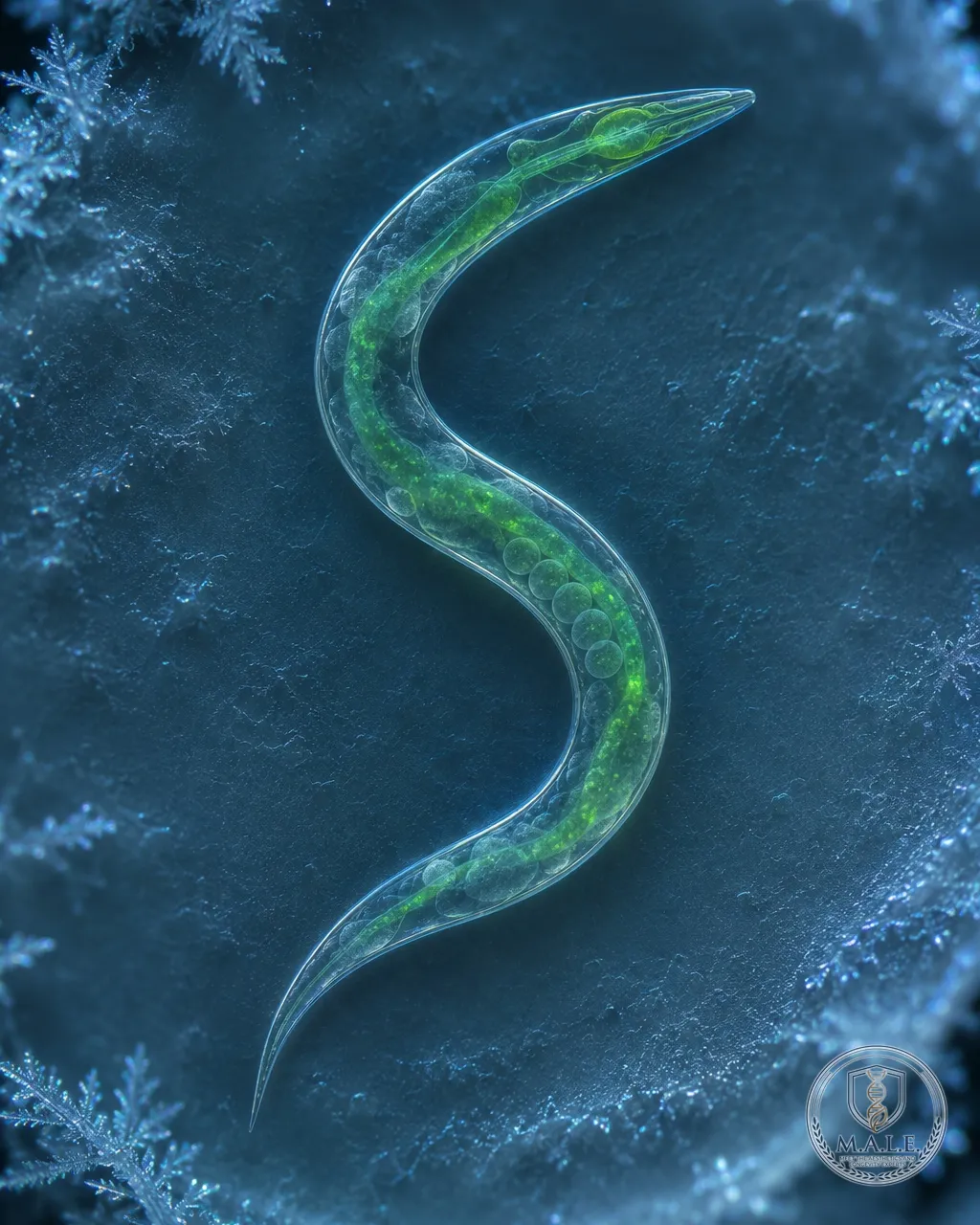
For over a century, it has been known that slightly lower temperatures extend the lifespan of worms, flies, fish, and rodents. However, the reason was unclear. A team from the University of Cologne has now identified a concrete mechanism: moderate cold causes muscles to produce a metabolite, dihydrobiopterin (BH2), which circulates to other tissues and helps them maintain functional proteins. The study appeared in Nature (online on October 21, 2026, in the November 12 issue). The results come from the worm C. elegans and human cell cultures, not from humans.
What the Researchers Discovered
The team led by David Vilchez (CECAD, the University of Cologne's cluster of excellence for aging) raised the worms at the standard temperature of 20 °C, then moved them to 15, 20, or 25 °C. Metabolic analysis showed dozens of metabolites specifically increased in the cold, and among the most important was BH2. Cold strongly activates the enzyme CAT-4, the equivalent of the human enzyme GCH1, the first step in the synthesis of biopterins.
How It Works
- The muscle acts as a "central factory": it produces and stores BH2, then releases it.
- In the intestine and neurons, BH2 is converted into BH4 (tetrahydrobiopterin), the active cofactor, by the enzyme DHFR-1.
- BH4 allows the enzyme PAH-1 to produce tyrosine, an amino acid that, in turn, supports longevity.
- Blocking this pathway reduces the benefit of cold on lifespan, so the effect is not just a passive consequence of a slower metabolism but an actively regulated process.
Cold Without Cold
The most interesting part: increasing BH2 synthesis only in muscles extended the lifespan of worms even at normal or higher temperatures, and supplementation with BH2 or tyrosine had similar effects. The pathway also reduced the aggregation of toxic proteins. In human cells, BH2 and tyrosine decreased the accumulation of proteins associated with Huntington's disease and amyotrophic lateral sclerosis (TDP-43, mutant FUS), and in human motor neurons with an ALS mutation, they reduced signs of programmed cell death.
"These results suggest that targeting a single tissue, such as muscle, could provide protection to the entire organism." (David Vilchez, University of Cologne)
Why It Matters for Clinical Practice
Exposure to cold, from cryotherapy to cold water immersion, is increasingly popular in wellness and longevity clinics, often with big promises and little evidence. The study does not validate these practices in humans but offers a plausible and testable mechanism: a muscle–metabolite–proteostasis axis. For the doctor interested in longevity, the useful message is another: muscle reappears as an endocrine organ, sending protective signals to the rest of the body, and maintaining muscle mass remains one of the most solid recommendations for healthy aging.
Study Limitations
- Longevity data is exclusively from C. elegans, a worm with body temperature equal to the environment; in mammals, including humans, body temperature is regulated.
- In humans, only cell cultures and models of neurodegenerative diseases were used; there is no data on skin or lifespan.
- The authors explicitly state that it is far too early for a "pill" to replicate the effects of cold. The study does not justify recommending tyrosine supplements or cryotherapy for anti-aging purposes.
The mechanisms by which mild stress (cold, exercise, caloric restriction) triggers protective programs are among the themes that will matter in longevity medicine, including discussions at M.A.L.E.
Sources
- Original paper: Lee H. J., Doğan C., Koyuncu S. et al., Vilchez D. (corresponding author), "Cold activates a BH2 metabolic network promoting longevity and proteostasis", Nature 659, 480–489, published online October 21, 2026, issue of November 12, 2026. DOI: 10.1038/s41586-026-11152-9
- University of Cologne (CECAD) press release: "Mechanism revealed behind the positive effects of cold temperatures on delaying aging and preventing age-related diseases", October 22, 2026. uni-koeln.de
- ScienceAlert, Peter Dockrill: "Cold Triggers a Hidden Molecular Pathway That Extends Lifespan, Study Finds", October 30, 2026. sciencealert.com
- Phys.org: "Newly identified metabolic pathway helps explain how cold extends lifespan", October 21, 2026. phys.org